Chapter · The Map
Metareligion as the Human Singularity
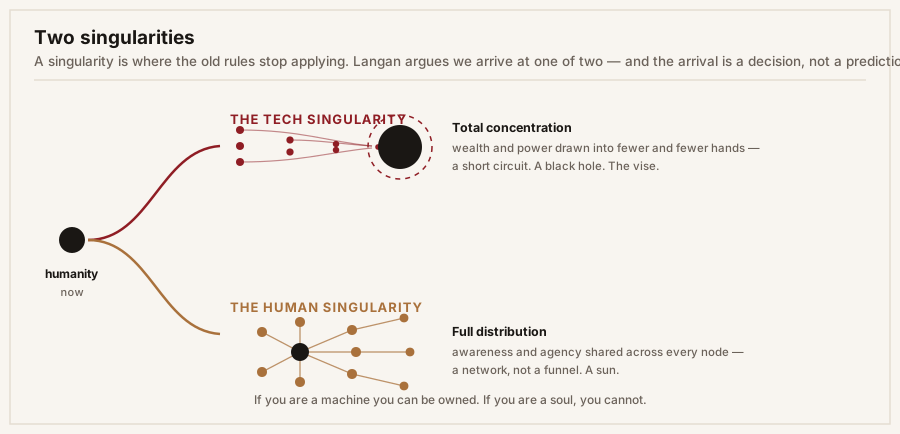
The Tech Singularity funnels everything into one point. The Human Singularity spreads it across a network. One is a black hole; the other is a sun — and the arrival is a decision.
The Crisis Nobody's Talking About
There's a war on, and most people don't even know they're the battlefield.
On one side: a worldview that says you're a machine — a collection of biochemical processes, driven by self-interest, reducible to your utility as an economic unit. On the other side: a worldview that says you're a soul — a being with intrinsic worth, connected to something larger than yourself, with a purpose that transcends the material.
These two views have been at war for centuries. Descartes formalized the split in the 17th century: mind on one side, matter on the other. Science took matter. Religion took mind. And never the twain shall meet.
This is called Cartesian dualism, and it's the single most destructive idea in modern history. Not because it's obviously wrong — but because it's subtly wrong, and its wrongness has poisoned everything.
Langan puts it bluntly:
"If human identity were ultimately pluralistic — existing in two essential or fundamental parts — then the equally fundamental gap between the parts would destroy its continuity, rendering it dissociative and pathological."
You can't live as a divided being. You can't build a coherent society on a divided foundation. And you can't find meaning in a universe that's been split into a meaningless material half and an impotent spiritual half.
This chapter is about the way out.
The Two Singularities
A singularity, in the mathematical sense, is a point where a system breaks down and must be redefined. In the social sense, it's a point of no return — a threshold beyond which the old rules no longer apply.
Langan argues that humanity is approaching not one, but two possible singularities. We will arrive at one or the other. The choice is ours.
The Tech Singularity
This is the one you've heard about. Ray Kurzweil, Elon Musk, the whole Silicon Valley narrative: AI surpasses human intelligence, technology accelerates beyond our ability to control it, and humanity either merges with machines or becomes obsolete.
Langan's take is darker than the popular version. He sees the Tech Singularity not as a glorious transcendence, but as a parasitic divergence — a process where wealth and power concentrate in fewer and fewer hands until the vast majority of humanity is reduced to the status of cattle.
"The top and bottom levels of society become the jaws of a vise which, due to the screwing down of the upper jaw against the anvil-like lower jaw, crushes the middle class and all meaningful competition out of existence."
The Tech Singularity is not just about AI. It's about control — who has it, who doesn't, and what happens when the gap becomes absolute. The technology exists to create a world where a tiny elite holds all the power and everyone else is a monitored, conditioned, disposable resource.
This is not a conspiracy theory. This is the logical endpoint of the dualistic worldview that has been driving Western civilization for 400 years. If you're a machine, you can be owned. If you're a soul, you can't.
The Human Singularity
The alternative is what Langan calls the Human Singularity — a mass spiritual awakening that redefines human identity from the ground up.
This is not "New Age" wishful thinking. It's a logical necessity given the structure of reality. If consciousness is fundamental (as the CTMU proves), then the human species is not an accidental byproduct of cosmic evolution — it's an essential ingredient of reality's self-configuration.
The Human Singularity is the point at which humanity collectively realizes its true nature and reorganizes society accordingly. It's the Omega Point of Teilhard de Chardin — an evolutionary terminus where matter and spirit reunite, and humanity achieves what might be called "Christ-consciousness" or simply full self-awareness as a species.
The engineer's translation: The Tech Singularity is a short circuit — a concentration of all energy into a single point that burns everything else out. The Human Singularity is a distributed network — an even distribution of awareness and agency across all nodes. One is a black hole. The other is a sun.
Why Religion Failed
If the stakes are this high, why isn't religion stepping up?
Because religion is broken. Not in its essence — but in its form. Religion has been crippled by the same dualism it claims to oppose.
Langan identifies the problem:
"Cartesian dualism is inconsistent with the spiritual connectivity demanded of religion, and thus makes religion inconsistent with empirical and mathematical science."
Religion says: "God is real, the soul is real, meaning is real." Science says: "Only what can be measured is real." These two claims are presented as irreconcilable. You have to choose.
But this is a false choice. It's a product of the dualistic framework itself — the assumption that mind and matter are separate substances that cannot be unified. The framework is the problem, not the content of either side.
The result is what Stephen Jay Gould called NOMA — "non-overlapping magisteria." Science gets the facts, religion gets the values. They don't conflict because they don't touch.
This is a polite fiction, and it's collapsing. When science claims that consciousness is an illusion produced by neurons, it's making a metaphysical claim — one that directly contradicts the religious claim that consciousness is the soul. The magisteria do overlap, and they are at war.
"Dualism fundamentally divides the world, leading to a seemingly endless sequence of futile attempts to patch it back together."
Metareligion — The Third Option
Langan's solution is not a new religion. It's a metareligion — a framework that underlies all valid religions without replacing them.
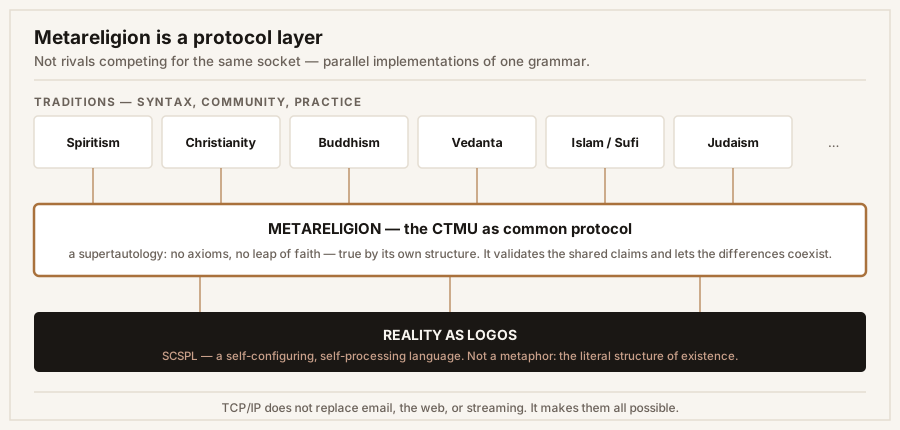
Think of it this way: different programming languages (Python, Java, C++) are different "religions." They have different syntax, different communities, different strengths. But they all compile down to the same machine code. The machine code is the metareligion — the common logical foundation that makes them all work.
"All intelligible languages include logic as a syntactic ingredient, which means that ostensibly independent languages share common syntax and are merely parallel aspects of one all-encompassing language, namely logic itself."
The CTMU is that machine code. It's a supertautology — a logical framework so fundamental that it requires no assumptions, no axioms, no leap of faith. It's true in the same way that logic itself is true: by its own structure.
This framework can serve as a common language for science and religion — not by reducing one to the other, but by showing that they are both expressions of the same underlying reality.
The engineer's translation: A metareligion is like a protocol — a set of rules that allows different systems to communicate. TCP/IP doesn't replace email, web browsing, and streaming video. It makes them all possible by providing a common foundation. Metareligion doesn't replace Christianity, Buddhism, or Spiritism. It provides the logical foundation that validates their shared truth claims while allowing their differences to coexist.
The CTMU as Logos
Langan makes a bold claim: the CTMU can be understood as Logos — the divine principle of order and reason that ancient philosophers saw as the organizing structure of reality.
"The CTMU is a reflexive, high-level kind of model theory designed to support the description of reality on the ontological level of discourse… the level on which reality exists independently of anything external."
In the Gospel of John: "In the beginning was the Logos, and the Logos was with God, and the Logos was God."
In the CTMU: reality is a self-configuring, self-processing language (SCSPL) — a logical structure that generates, maintains, and processes itself. The Logos is not a metaphor. It's the literal structure of existence.
This is not blasphemy. It's the reunification of science and spirituality on a level deeper than either has reached alone.
"Encoding the relationship between man and Deity, humankind and the metaphysical structure of reality, it is the only valid basis for eliminating the existential confusion and religious conflict that threatens our world without sacrificing that which makes us human."
What This Means for You
1. You Are Not a Machine
The dominant worldview says you're a biochemical robot — a collection of evolved mechanisms that produce the illusion of consciousness. This worldview is not just wrong. It's logically impossible given the structure of reality.
The CTMU proves that consciousness is fundamental. You are not an emergent property of matter. You are a syntactic operator — a unit of self-processing information that participates in reality's ongoing self-configuration.
What this means: Your choices matter. Your consciousness is real. You are not a passenger in the universe — you are a driver.
2. The Choice Is Real
Humanity faces a genuine fork in the road. One path leads to the Tech Singularity — a world of total control, where the gap between the powerful and the powerless becomes absolute. The other leads to the Human Singularity — a world of distributed awareness, where every individual has access to the full depth of their own being.
This is not a prediction. It's a decision. And it's being made right now, by every person who chooses to see themselves as a soul rather than a machine.
"In order to have a meaningful mass awakening, the content of the awakening must be defined and distributed to the members of humanity, thus immunizing them against parasitic mind control."
3. The Framework Already Exists
You don't need to invent a new spirituality. You don't need to choose between science and religion. The framework that unifies them already exists — the CTMU, understood as the logical structure of reality itself.
This framework is not a belief system. It's a tool — a way of understanding reality that makes both science and spirituality more powerful, not less.
The engineer's takeaway: The universe is not a machine. You are not a machine. The choice between the Tech Singularity and the Human Singularity is the choice between treating yourself as a machine and recognizing yourself as a soul. The CTMU provides the logical foundation for making that choice with your eyes open.
The Bottom Line
Langan ends his paper with a quiet plea:
"Let us hope that there are enough of them to help us attain the Human Singularity, and redeem mankind from its otherwise gloomy and potentially catastrophic future."
This is not a prediction of doom. It's an invitation — to see clearly, to choose wisely, and to participate in the most important decision humanity has ever faced.
The Tech Singularity is coming whether we want it or not. The only question is whether we arrive at it as slaves or as sovereign beings.
The Human Singularity is the alternative. It's not guaranteed. It requires work — the work of waking up, of seeing through the dualistic illusion, of recognizing yourself and others as souls rather than machines.
But the framework exists. The path is clear. And the choice is yours.
[Testable] — Can you verify the claims of metareligion? Not by reading a book, but by living:
- Do you experience yourself as a machine or as a soul? The answer is not a belief — it's a direct experience.
- Do you see others as machines or as souls? The answer determines how you treat them.
- Do you see the universe as a machine or as a living process? The answer determines what you think is possible.
The metareligion of the CTMU doesn't ask you to believe anything. It asks you to look — and to choose accordingly.
"The universe is not a machine being operated by a mechanic — it's a language being spoken by itself, and you are a word in that language with the power to choose your meaning."
Disagree with any of it? Good.
Write to us. A challenge to this chapter is more useful than an agreement with it.
Write to us