Chapter 1 · The Practice
Physical Health and Diet
You cannot build a spiritual practice on a broken chassis. The foundation chapter — clean fuel, nine dietary systems, and the fine line between using the body and becoming it.
Why This Is the First Step
Welcome to the first chapter of the Practice section. If you take nothing else from this book, take this: diet and physical health are the foundation. You can't build a spiritual practice on a broken chassis.
It's a hard reality, but if you're going to have a spiritual lifestyle, you're going to need a lifelong dietary system that backs you up at all times. It has to be there. In fact, some people can make the dietary lifestyle of their spirituality carry them a long way on its own. A good diet and solid physical health will take you further than most techniques will. But without it? You're not going to be able to meditate. You're not going to be able to do yoga. You're not going to achieve any sort of degree of purification — of either your soul or your body.
Unfortunately, or fortunately — depending on how you want to view it — diet is just something you're going to have to carry with you, ongoing, at all times while you progress in your spiritual advancement. There's no shortcut. There's no "fix it once and forget it." It's a lifelong relationship with what you put in your body.
The Machine Analogy
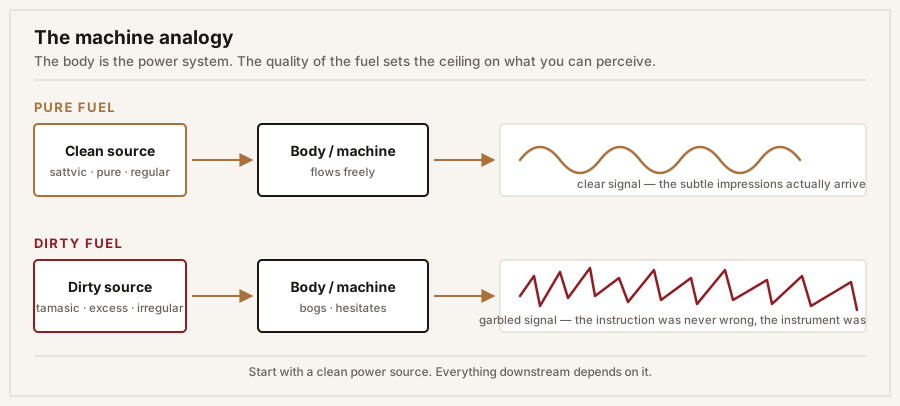
Why does this matter? Let's think about a machine. One that runs on fuel, or one that runs on electricity — doesn't really matter. The power source, the thing that gives the machine its energy, will run better if that source of energy is pure and clean.
What happens to an engine that has dirty fuel? It breaks down faster. It doesn't run as well. It doesn't produce as much power. It sputters, it bogs, it hesitates — all kinds of problems. Or think about a computer system with inconsistent, glitchy power. The computer generates errors. It bugs out more. It resets, crashes, glitches — causes problems.
Your body, viewed as a biological machine, is no different. You need a clean power source. You need clean fuel. That's where diet comes in.
To put it plainly and directly: you're not going to be able to feel any of the subtle things — the energies, the impressions, the sensibilities that meditators and yogis talk about — if your body isn't tuned up enough to actually feel them. You will struggle with meditation and with any subtle technique if your body isn't flowing properly. Plain and simple. This is just a fact.
That's why this is the first chapter of the Practice section. If you can get this managed first and right away, you will solve a lot of problems for yourself later down the road. Start with a clean power source. That's your diet and physical health.
The Options — A Toolkit, Not a Doctrine
I'm not going to go deep into any one dietary system in this chapter. That's not the point. What I will do is give you a list of a few of them. Go find the one that works best for you, and then apply it. Chances are, if you're going to spend multiple years on a spiritual path, you're going to explore several different dietary systems. That's okay. That's normal.
For a long stretch of my practice I used Ayurveda. It worked 98% of the time. It's an extremely rich system, and I highly, highly recommend it. That said, individual to individual, some of us used slightly different things or incorporated elements from other systems. Myself, I found that the Blood Type Diet worked quite effectively for me personally.
Here are some of the major spiritual dietary systems from around the world. Each one has centuries (or millennia) of development behind it. Each one works. The question is which one works for you:
- Ayurveda / Sattvic Diet — The three gunas (sattvic, rajasic, tamasic). Fresh, pure, plant-based foods that promote clarity and lightness. Avoids onion, garlic, caffeine, meat, alcohol, processed foods. The gold standard for yogic practice.
- TCM / Taoist Five Element Diet — Foods classified by energetic qualities (temperature, flavor) tied to organs and seasons. Balances Yin and Yang. Eaten seasonally and mindfully.
- Buddhist Dietary Practices — Varies by tradition. Mahayana/Zen: strict vegetarian, avoids "pungent roots" (onion, garlic) that excite the senses. Theravada: eat what's offered. All rooted in ahimsa (non-harming).
- Islamic / Sufi Guidelines — Halal + Tayyib (permissible + pure). Avoids pork, blood, alcohol. Sufi tradition adds ascetic simplicity and fasting for remembrance of God.
- Jewish Kosher (Kashrut) — Detailed laws of permitted animals, separation of meat/dairy, proper slaughter. Elevates eating to a ritual act of holiness.
- Christian Fasting Traditions — Orthodox, Catholic, Desert Fathers. Rhythmic abstinence (Lent, Wednesdays/Fridays) from meat, dairy, eggs, oil. Fasting as purification and reliance on God.
- Macrobiotic Diet (Ohsawa) — Yin-Yang balance through whole grains, vegetables, seaweeds. Inspired by Zen and Taoism.
- Indigenous / Shamanic Dietas — Restricted diets (no salt, sugar, spices, sex) for weeks or months to "hold" a plant's spirit. Fasting for vision quests and spirit contact.
- Blood Type Diet (D'Adamo) — Modern, science-inspired. Eat according to your ancestral blueprint (Type O = hunter, A = agrarian, B = nomad, AB = mixed). Simple, personalizable, and surprisingly effective for many.
The common threads across all of them:
- Mindfulness in eating
- Purity and cleanliness as spiritual preparation
- Moderation and avoidance of excess
- Ethical relationship to what you consume
- Fasting as a universal spiritual technology
- A plant-based emphasis across most traditions
Get out there, find a dietary system that works for you, and get your body purified. The best diet is the one you'll actually follow.
The Obvious Stuff
Let's talk about some obvious — and some not-so-obvious — things when it comes to having good physical health on the spiritual path.
The obvious:
- If you're overweight, lose weight. If you're too thin, put on weight. Get yourself to a healthy baseline.
- No drugs. No alcohol.
- Try your best to have no caffeine. This one I personally struggled with a lot. I really, really loved my coffee. And I worked with blue-collar men. Let's be honest, boys — we love our coffee. Kicking coffee permanently was extremely difficult for me. Maybe for you it'll be easy. But I don't drink, I don't smoke, I don't do drugs. Those are the obvious ones.
- Have a certain minimal level of physical fitness. Yoga is extremely good for this. A simple yoga practice about half an hour a day is plenty.
The Not-So-Obvious Stuff — The Fine Line
Here's something that dietary systems won't really talk about. Something specifically related to spiritual advancement.
If we can agree that the goal of spiritual advancement is to move yourself more and more toward the spirit — toward the soul — then you're going to strip away your investment and attachment to the material world, including your physical body. You're going to move your center of identity. You're going to move the place from which you always start — not from your form, but from your soul.
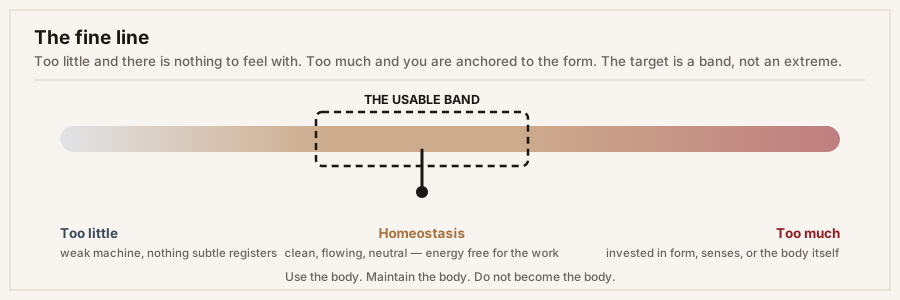
This means: you want to be healthy, but you don't want to invest too much energy into your body. That would lock you into materiality, into your physical form, more than you need to.
For example: if you go to the gym too much and you're a big bodybuilder with huge, hulking muscles — you're extremely fit, and that's excellent — but you should probably reduce this. You want to move your attachment away from your physical body and onto your soul. The same goes for attachment to lots of sex, or to food, or to any of the senses. If you're too invested in stimulating your physical senses, you're going to inhibit your spiritual path.
In spiritual practices, there is an emphasis on decreasing your attachment to the physical body while simultaneously increasing its purification. The methods for this are dynamic and varied. Diet and minimal physical exercise are at the core of most of them. But some traditions also advertise chastity, fasting, or other practices that remove your attention and emphasis from the physical body and center you on your more energetic bodies — which we'll get into later.
So here's what I want to say: if you're too invested in your body and you want to take your spiritual path seriously — using the example of a bodybuilder or someone who exercises all the time — being extremely fit is good, but it can hinder you on your spiritual path if you're too invested in it. The same goes for sex, food, or any of the senses.
You're walking a fine line. It's a balancing act.
You want to be healthy and fit enough that the power system that is your body is clean and flowing well. You don't want problems. But at the same time, you don't want excess either. You don't want too much physical. You don't want too much stress on the body. You don't want too much investment in sex or satisfying the senses.
You want to be in a place that is more balanced. More neutral. Just maintaining a good position of homeostasis. And from here — when the power system is at least flowing properly, when the machine is working well — the remainder of your energy can be directed toward your actual spiritual advancement.
Try This
Pick one dietary system from the list above. Commit to following it — even imperfectly — for 30 days. Not "trying it out." Not "seeing how it feels." Actually follow it. At the end of 30 days, assess:
- How is your energy level?
- How is your mental clarity?
- How is your meditation or practice?
- How is your relationship with food?
If nothing changed, try a different system. If something changed, you've found your starting point.
[Testable] — This is the most testable claim in the entire book. Change what you eat for 30 days. Observe what happens. The data will speak for itself.
Disagree with any of it? Good.
Write to us. A challenge to this chapter is more useful than an agreement with it.
Write to us